TEMPORARY NODE WITHIN A COMPLEX MESH
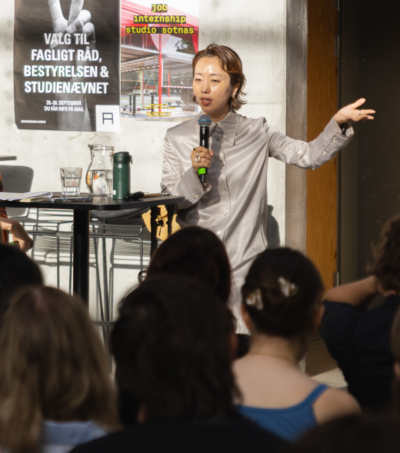
To address the challenges of global warming and ecosystem destruction driven by the material cycles of a capitalist society rooted in mass production and consumption, Mio and Fuminori approach architecture as a temporary node within a complex mesh of resources, knowledge, technology, and institutions. “The mesh is actually based on Bruno Latour’s actor-network theory,” Mio explains. “It’s not just about materials or resources, but also technologies, skills, laws, institutions, infrastructures—all of which shape the environment we build in. Architecture, as we see it, from resource to decomposition, is just a temporary state within this complex mesh.”
It’s easy to see the material chain—from nature and raw matter to reuse or trash—but behind that chain lies a whole network. “How we extract materials depends on our knowledge and skills, but also on systems of supply and logistics,” she continues. “The supply chain is shaped by regulations and industrial priorities, which tend to be based on fast supply and fast consumption. So the mesh isn’t only made of actors—it’s defined by how those actors connect.”
For Mio and Fuminori, designing architecture means designing that mesh and rethinking how rules, tools, materials, and skills interact. “Our role is to find new combinations, new ways of working with this system so we can decompose materials back into the soil—not just pile things into landfills.” This view also reframes the meaning of demolition, renovation, and construction. “As I said earlier, demolition, building new, or transformation—they’re all ways to circulate materials,” Mio says. “We can build with new materials, sure. But what kinds of materials? How long will they last? What can be reused later on? Can they go back to the soil? How long will that take? That’s the mindset we need.”





 Muhsin Akgün


 Les Kaner