URBAN ELEMENTREE
Through interdisciplinary research, trees’ interaction with the urban built environment can be better predicted, enabling more effective urban planning.

Through interdisciplinary research, trees’ interaction with the urban built environment can be better predicted, enabling more effective urban planning.
Billions of trees are to be planted in the EU, both through afforestation and in cities. This is happening both to improve climatic comfort in urban spaces, to bind CO2 in the soil and in the trees themselves, and to try to curb the mass extinction of species and extreme biodiversity impoverishment in the environment. However, many tree-planting efforts have failed because growing conditions in cities have become harsher, and there is a lack of tools and processes for systematic preliminary studies that can inform design decisions regarding tree planting. In addition, after planting there is a need for monitoring how the trees thrive and interact with their surroundings. Furthermore, existing research and experiments have focused on solving individual environmental factors and challenges without gathering and connecting the knowledge gained.
Trees have complex properties and interact in various ways with their surroundings, which makes it difficult to accurately predict their impact. There is therefore a need for interdisciplinary, collaborative approaches that integrate new research with practical knowledge and data collection in order to improve future urban planning initiatives and successful, fast, and cost-effective tree plantings.
In order to achieve sustainable urban planning, it is necessary to develop urban green infrastructure that takes into account both environmental and health benefits, while also considering cost-effectiveness and the long-term thriving of the trees.
Through interdisciplinary research, trees’ interaction with the urban built environment can be better predicted, allowing us to achieve more effective urban planning.
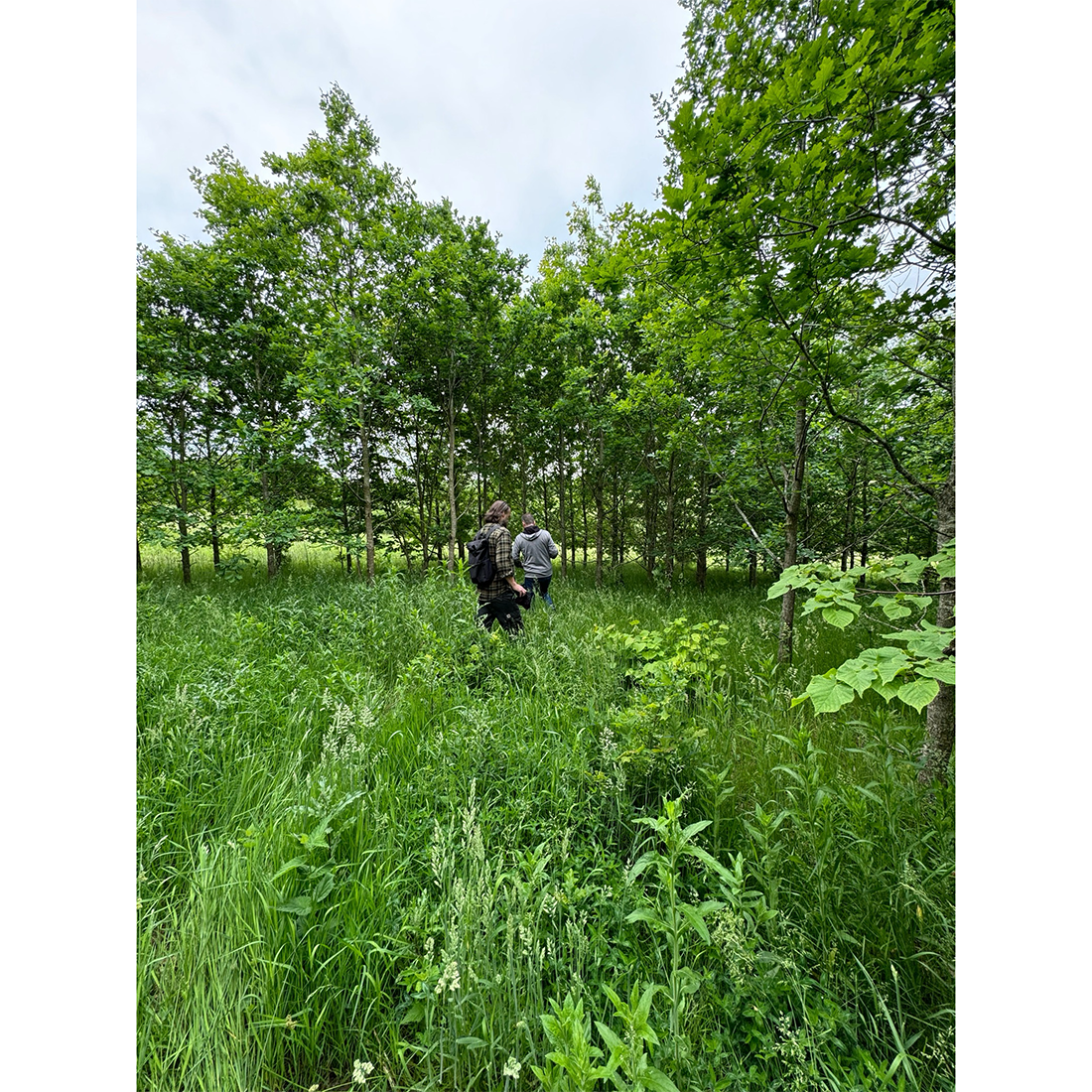
Urban ElemenTREE focuses on interdisciplinarily developing analysis methods to optimize the selection of tree species and planting locations. Climate change is challenging the huge tree-planting project the EU has launched, because drought, extreme wind, extreme heat and cold, and flooding pose risks that may prevent the trees from thriving. Furthermore, incorrectly planted trees in cities can also pose a risk to people and infrastructure in extreme weather.
By comparing planting policies and environmental practices in five European cities with different climatic and demographic conditions, the project will create a shared foundation for the development of Urban Living Labs. The Urban Living Lab in Spørring, which Aarhus is contributing, will investigate how the distribution between food production, energy production, and tree-planting projects is negotiated in rural areas around cities, where they compete for land.
In the labs, researchers from different disciplines will work closely together to carry out case studies under various local conditions and challenges, in collaboration with diverse stakeholders such as planners and municipal administrations. Different monitoring methods, involvement of citizens in citizen science experiments, design approaches, etc., will be tested, and digital tools will, among other things, help collect data on how the trees’ health and growth can be ensured.
The project will gather the newest, but currently fragmented, research and translate it into usable guidelines and tools for stakeholders, planners, and decision-makers.
In addition, Urban ElemenTREE will develop shared, data-based methods as well as digital platforms and tools that make it possible to optimize the selection of tree species and planting locations, so that cities’ green solutions match specific environmental conditions. This should lead to more sustainable urban environmental management that can be implemented in, and support, inclusive initiatives.
Facts
 https://aarch.dk/wp-content/uploads/2026/09/download-152.jpg
400
400
apparat
https://s3-eu-central-1.amazonaws.com/aarchdk/wp-content/uploads/2019/02/03164631/aarch-logo-dark.svg
apparat2026-09-03 16:24:512026-09-03 16:24:53Lotte M. Bjerregaard Jensen
https://aarch.dk/wp-content/uploads/2026/09/download-152.jpg
400
400
apparat
https://s3-eu-central-1.amazonaws.com/aarchdk/wp-content/uploads/2019/02/03164631/aarch-logo-dark.svg
apparat2026-09-03 16:24:512026-09-03 16:24:53Lotte M. Bjerregaard JensenRelateret


 Practical Information