
Dust: Stories of efforts
‘Dusty relief’ and ‘The Large glass’ embrace serendipitous assemblages of open-ended designs that develop over time, conceptually embracing dusty processes. However, oftentimes working with another omnipresent type of dust – construction waste requires a bit more effort, as past and current systemic and individual endeavours present. The exhibition for Open Festival 2026 unfolds in five stories that showcase diverse attempts to navigate dusty sceneries, post- or pre-demolition landscapes reconstructing cities, renovating buildings and saving discarded materials.
The first entry examines the history of the seemingly utopian rebuilding of Warsaw, ruined during the Second World War, where very few buildings remained intact. What was left were humongous piles of building rubble, omnipresent clouds of dust, and ashes of the burnt city. The symbolic act of rebuilding the Polish capital was an example of an unprecedented collective effort, an immense labour endeavour, but also a case of innovative engineering that mobilised the postwar rubble to construct the new-old city.
The second story looks into the activist position that questioned a planned demolition of the abandoned farmhouses and turned them into a municipal community house Kvarterhus Køge Nord Skov. In this project, developed by dominique+serena, saving the buildings from becoming dust meant initiating dialogues with the municipality, instigating participatory engagement, considering cost-effective transformation scenarios, securing funding, conducting expert studies and organising resources to reverse the intended trajectory.
The third tale follows discarded material flows in Brussels, examining the practice of the architectural collective Rotor, which has been scouting for dusty matter for the last twenty years, eventually developing a cooperative specialising in dismantling, sorting, cleaning, and selling reusable building materials. Current undertakings include organised material repositories, developed on-site and off-site logistic procedures, and policy recommendations while developing architectural proposals with second-hand building elements.
The fourth case focuses on strategic design decisions, on-site dust scavenging and related economic considerations that influenced the adaptation of an existing office building in Brussels to become a Karreveld school. The low-cost project, initially conceived by AgwA as a temporaryappropriation, mobilised meters of ‘as found’ partition walls to create new spatial divisions. This local sourcing was followed by meticulous measuring, dismantling, sorting and pragmatic processing of the boards to comfortably host the new educational programme.
Finally, the fifth story investigates the recycling processes and material testing efforts that turned the dusty particles, leftovers from crushed façade panels in the redesign project of Sct Peder in Næstved, developed by Panum & Kappel in collaboration with BB Fiberbeton and supported by Realdania. This entry looks into the process of mixing, optimal particle ratios, required material tests and careful detailing. The seemingly simple process of recycling becomes challenging once the structural, aesthetic and socio-cultural objectives multiply.
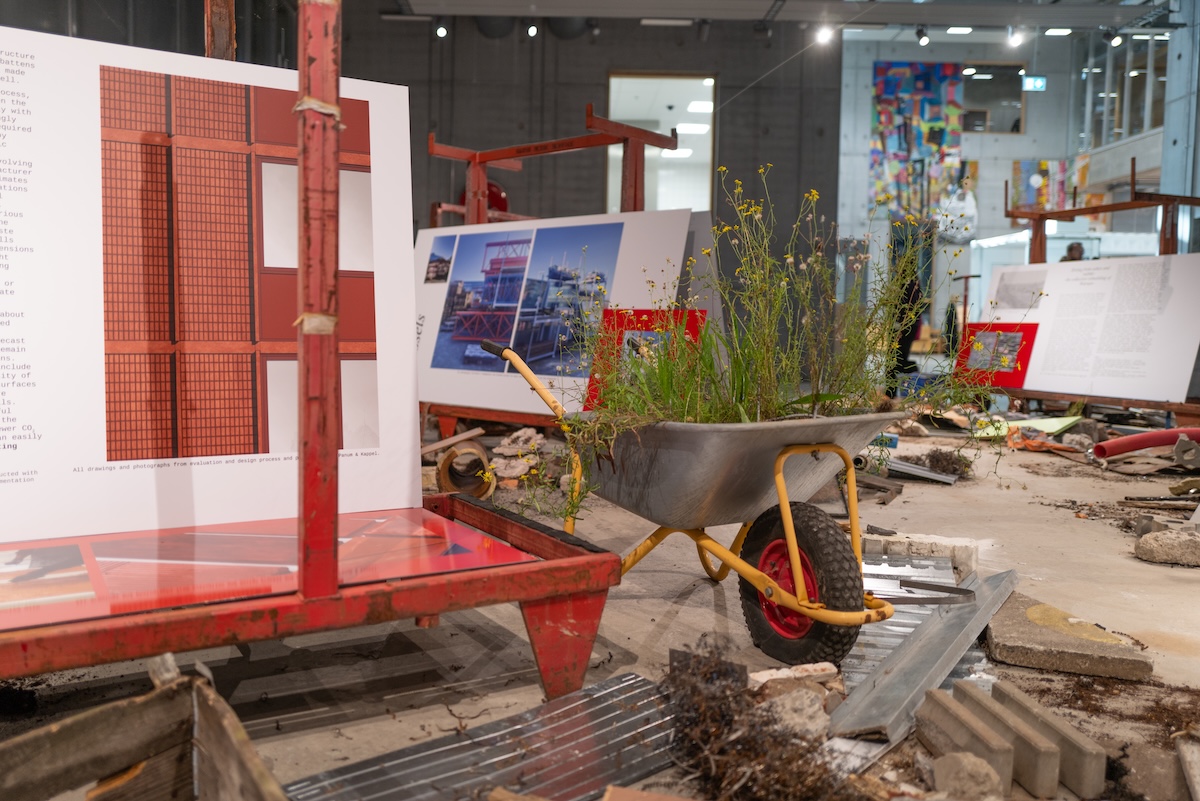 Dust: Stories of Efforts // Ula Kozminska
 Rediscovering Openness by SLETH Architects